Showing posts with label Natural History. Show all posts

Wednesday, March 15, 2023

Natural History of the Spotted Turtle (Clemmys guttata)

    A cool herp I encountered is the Spotted Turtle (Clemmys guttata) during spring break on 3/4/2023. Spotted Turtles are generally very small (carapace is usually between 3-5 inches). They are smooth and black with several yellow, and sometimes a few orange, spots on their shells, heads, and limbs. Each individual has a unique spot pattern. This was a very lucky day because Spotted Turtles are considered endangered by the IUCN Red List. Due to this, I won't share their exact location. I'd never seen these in the wild before this encounter!

    This was particularly exciting because there were several individuals in this locality. I spotted (no pun intended) about 17 individuals in one day of various life stages. This population was inhabiting a very random pocosin, which is a freshwater wetland area surrounded by evergreen trees and shrubs. Spotted Turtles usually inhabit swamps, marshes, woodland streams, and wet pastures, so this made sense. They tend to avoid deep, open water. I noticed that they were mostly found around areas with lots of aquatic vegetation and sticks. Spotted Turtles are most active during early spring, so this was the ideal time to find them! 🐢🌞

    I was stoked to find a juvenile. This means that the population is doing well enough to be reproducing. This individual is likely around 2 years old- it's far too small to be an adult, but not as small as a neonate hatchling. Since it's so young, this individual could not be reliably sexed. Like many other turtle species, juveniles tend to resemble tiny versions of adult females. A sexually mature female would have a flat plastron, short and thin tails with the cloaca close to the body, and yellow to orange irises. In contrast, males would have concave plastrons, longer and thicker tails with the cloaca further away to house their penis, and dark brown irises. 


I love that little face...

    This juvenile turtle was very shy at first but ended up having a sassy attitude. I found it casually swimming just under the surface of the water, as it couldn't see me from there. Similarly, many of the adults were also actively hunting in the water. However, basking individuals would spot me from several feet away and retreat to the underwater leaf litter. This juvenile had a chunk missing from one of the marginal scutes, and so did many of the adults. Theoretically, this could be because most individuals had orange spots on the sides of their heads and on the rear end of their carapace, which could be confusing to a bird or other predator.

Check out the chunk missing from this kid's scute!

    Overall, I'm super grateful to have had this experience and wish it was more commonplace to see Clemmys guttata in the wild. During and after this encounter, it was bittersweet. Although it was thrilling to find a seemingly persistent population, it was emotionally difficult to consider that they may not be around much longer due to anthropogenic faults such as pollution, vehicular mortalities, habitat destruction, and poaching. 

Tuesday, April 3, 2018

Eastern Red-Backed Salamander


    During spring break, I had the opportunity to work with the Chesapeake Bay Foundation (CBF). On March 19, we worked to restore a tree buffer around a farm in Maryland. While moving some around some tree litter and brush in order to plant a new tree, we came across a salamander! The salamander was dark brownish on the sides, had a red middorsal stripe, a long, slender body, a tail nearly as long as its body, four toes on the front feet and five toes on the hind feet. David, from CBF, quickly identified him as an Eastern Red-Backed Salamander, a very fitting common name. The scientific name is Plethodon cinereus. P. cinereus is in the Family Plethodontidae, the lungless salamanders with nasolabial grooves. 
    David said they are very common in Maryland and that you can flip over almost any log and find one. They are a woodland salamander and have no aquatic larval stage, thus their life history is direct development. The male will lay a spermatophore in a moist area and the female will pick it up and internal fertilization occurs. She will then lay her eggs in a damp area, under a log or rock. I was unable to identify the sex, as we had to get back to work. If it was male, he would have a metal gland under the chin. The species is somewhat sexually dimorphic with the females being slightly larger. Their average size it 5 to 12 centimeters long, according to Peterson’s Field Guide. It was a very exciting experience to find a salamander in the tree buffer around the farm. The tree buffer is not only filtering the runoff from the farm but also providing a habitat for other species that would not live there without the trees.


Sunday, April 22, 2012

NATURAL HISTORY: Two-toed amphiuma!

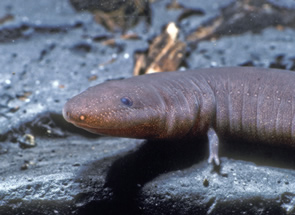
Check out this wickedsweet slimy thing we caught in a swamp!

To freedom!

So, the traps in the swamp yielded a few really good finds: two sirens, and this guy, the two-toed amphiuma. It's a good thing that swamp housed so many cool herps, or I'd never forgive it for trying to swallow me.

The major distinguishing characteristic among amphiumas are the toe numbers: there are one-, two-, and three-toed amphiumas. Amphiuma means is the two-toed amphiuma, and if you look at those tiny little appendages below its head, those are its arms. It has both arms and legs, each with two toes. Two tiny, tiny toes.

The tiniest.

All members of the family Amphiumidae have these ridiculously small arms, gill slits, and laterally compressed tails, all of which indicates that they are entirely aquatic, and the fact that they retain these traits into adulthood indicate that they are obligate paedomorphs. They are nocturnal; they hang out in burrows during the day and hunt at night. They are quite active hunters, but I will get to that later; right now, I want to talk about their slime. Amphiumas produce huge, really off-putting quantities of mucus. It's super gross, but also super cool, because they can use this mucus to estivate: when it becomes too dry, they hunker down in a nasty little mucous cocoon, retaining moisture and waiting out the drought. They also use it to retain moisture for trips on land. They can use their tiny arms to scoot themselves along on land, really slowly. Here is a video of an amphiuma doing that.


Amphiumas have to get on land for reproduction. Amphiumas have internal fertilization, and they do it kind of like birds, with the cloacal kiss: they get right up next to each other and the male deposits a spermatophore (or maybe just sperm in non-packet form) into/onto the female's cloaca. Eggs are laid on land, in hollow logs or some other suitably burrow-y place, and the female attends the eggs until they hatch.
 
Totes adorbs.

So, about amphiumas as predators. They eat aquatic crustaceans and insects and I think small fish as well—anything that will fit in their mouths and not kill them. Here is a pretty cool video of an amphiuma eating a crawdad, and then dealing with the fact that it just put an angry, pincer-bearing thing inside its body.


Amphiumas live in the southeast, in swamps and sometimes in rivers, but mostly in swamps. Swamp water isn't totally stagnant, of course, but it's definitely not moving at, like, river-like speeds, and so it's not as well oxygenated as river water. Additionally, amphiumas have gill slits, but not external gills. This should make no sense: the amount of oxygen available to an organism via its gills is a function of the concentration of oxygen around the gills and the surface area of the gills, but these guys have, like, no gill surface area. Small gills are very disadvantageous in a swamp, and yet, these guys have gill slits, not even proper gills. This is because they have these awesome lungs, which provide them with just over half their oxygen; they breathe really infrequently and give the oxygen a really long time to diffuse, and so make really good use of each breath. So, that is pretty cool.

These guys are pretty angry; they can bite super hard, and the one we caught looked super pissed-off the whole time, although that's also kind of what amphiumas look like by default. According to Wikipedia and one comment on an article I'm going to link, amphiumas can make a high-pitched cry when they feel threatened, but I haven't seen that anywhere else, so if someone can verify that from personal experience or otherwise solid knowledge, that would be awesome.


Check these things out!
  1. There's an amphiuma article on TetZoo! You guys, I believe I have told you this already, but I love TetZoo.
  2. The source of the amphiuma videos. These are all three-toed amphiumas, Amphiuma tridactylum, rather than two-toed ones.


Sunday, April 1, 2012

NATURAL HISTORY: The Leaf-Tailed Gecko!

Do you all remember when we went to the aquarium, and we got to see the herps that had come in for the Madagascar exhibit, and there were those leaf-tailed geckoes? They'd all stuck themselves up along the sides of the tank they were in, and they were super adorable clinging to the glass, right?

As it happens, they were only adorable because we couldn't see their eyes.

Doom arrives on setae-laden feet.

LEAF-TAILED GECKO STATS
  • Genus: Uroplatus
  • Species: 13
  • Terrain: Arboreal
  • Activity: Nocturnal
  • Diet: Insects
  • Weirdness: In spades

Leaf-tailed geckoes are all native to Madagascar, and there are 13 currently known species. They range in size from 4-12 inches, and like all geckoes, they are direct-developing amniotes. The fearsome-looking guy above is Uroplatus fimbriatus, and he is super angry; when he feels threatened, he will scream at you. Because it is daytime, his pupils have constricted to leave red-lined, soulless orbs. Leaf-tailed geckoes' pupils are highly constricted during the day because their eyes are phenomenally sensitive and are evolved to make them great night-time predators. At night, their pupils dilate to take up almost the whole visible surface of their eyes.


Crazy huge pupils.

Common to all Uroplatus are their flat tails and their overall tree-ish coloration, and they tend to have all kinds of weird texturing so that they look like bark. Their eyes are mottled so that they look like lichen. In addition, they have this fractal fringing all along their sides, and around their jaws and each of their toes, which disrupts their outline like nothing else. They are just incredible at camouflage. Here, try to find the U. sikorae in this picture.

Pro at camouflage.

As geckoes, these guys are arboreal, and they're nocturnal as well—not always the case with geckoes. They have an obscene number of very tiny teeth—around 130—which is super cool, although we don't know why they have all of them, because they eat insects, just like other geckoes. It would stand to reason that if their diet is similar to that of other geckoes, then their teeth should be similar, too. But they're not. So that's something new and fun to research if gecko dentition is of interest to you!

Some other physical characteristics of leaf-tailed geckoes:
  • Super large head
  • Widened toes, toe pads
  • Reduced abdominal musculature
  • 11 - 13 inscriptional ribs (as opposed to few/none)—inscriptional ribs are cartilaginous rib-like structures in the abdominal muscles; this possibly makes up for the reduced abdominal musculature
  • Reduced depressor mandibulae--this is weird because they're scleroglossians, so they need some good chomping action to hunt, although they seem to be fine without it, so maybe it's reduced to keep the mass of the head down?
  • Incipient secondary palate—there is just so much weird mouth stuff going on!
So here is the weird thing, though: we don't know what a lot of their anatomy is for; we have a serious dearth of knowledge of why they do anything, and we have been studying these guys pretty consistently since the mid-1600s. Here is a plate from the 1700s illustrating that point.

I am a total sucker for old-school scientific illustration. (This is by Lacépède and you should definitely check him out.)


MORE!
  • Check out this slew of leaf-tailed gecko videos from Nature!
  • This is one of the articles I read and it was just wonderful.
  • Cited in that wonderful article is this paper which you should take a look at if you are super excited about leaf-tailed geckoes and/or have a lot of time-- it is long and really comprehensive.

Sunday, March 18, 2012

Natural History: Trachemys scripta


This turtle was photographed at our latest field trip to the Aquarium. While the Aquarium is a great place to observe these turtles, their typical habitats are freshwater sources such as lakes and rivers. This particular species is also a popular pet due to its ease of care and omnivorous diet.

Trachemys scripta also known as the yellow bellied slider can be identified by their characteristic yellow stripes down their head and limbs, as well as their yellow plastron. This particular turtle appears to be female due to its large size and short claws.

I was fortunate enough to see this turtle as it was basking under the heat lamp allowing me to take a picture in which she appears to be posing. This species of turtle starts to lose its distinctive markings as it ages which I witnessed first hand when I saw an older yellow bellied slider in the same habitat as the slider pictured. I wanted a picture of this turtle as well but it proved to be too dark for my camera which lacked flash.

Natural History: Hyla Cinera

Natural History: Hyla cinera, The Green Treefrog

I came across this handsome little guy one day on my screen door. About the size of a quarter, he is almost fully grown, as they only get to be anywhere between 1 and 2 inches long. As seen, he is bright green in color, but his lateral stripe was not noticeable, however I did not want to disrupt him so I looked from a far.

While trying to take a picture of this little guy it was almost as if he was posing for the camera. He glanced back, as seen in this photo, and stopped climbing across to try to find a hiding spot. He was very photogenic!

The green treefrog is an inhabitant of almost any place that has a good supply with water or dampness, including swamps, streams, floating vegetation, etc. They are also found largely throughout the southeast - South Carolina, of course, Georgia, Florida, even as far as some parts of Texas.

In addition, in our field guide it even says that they are "frequent visitors to windows at night, where they seek insects attracted by lights," and that is exactly where I found him, my screen door window!