Wednesday, April 29, 2015

Natural History: Ground Skink

Species: Ground Skink
Scientific name: Scincella lateralis


The smallest skink in the Scincidae family, the ground skink measures roughly 3 to 5 inches. This species has a smooth tan body with a dark stripe down the length of its side (dorsolateral). Fun fact: The ground skink has a transparent disk in the lower eyelid that allows the skink to see when its eye is closed! A new take on sleeping with your eyes open. This small skink scampers over the leaf litter on the floor of the woods. A very skittish creature that takes refuge in the nearest hiding place. As we walked through the trail at Dixie Plantation, a small movement caught my eye. I immediately stopped walking and glanced down. There on the leaves was a ground skink! In a flash, I reach down and scooped it up. I was unable to determine the sex of the individual I caught, but from the size I inferred that it was an adult. The ground skink can be found in along the eastern coast and throughout the southern states. 
I was extremely lucky in catching the ground skink as they are fast creatures that do not hesitate to run to shallow water to escape predation. With their small size, they can easily disappear from view. It was a great field trip! Not only did I catch a ground skink, but we saw a hognose and a timber rattlesnake! It was a very exciting time! With each trip after, I seem to attract the ground skink and have since caught several others on different trips! The ground skink is a pretty cool species and one that is easily recognizable from other lizards.


Class Mascot- Loggerhead Sea Turtle


I think that our class mascot should be the Loggerhead Sea Turtle, or Caretta caretta. On our field trip to the South Carolina Aquarium we saw several loggerheads in the Sea Turtle Hospital. These turtles were recovering from bacterial infections, motor boat accidents, and exposure to cold temperatures. The loggerhead is a great species to represent our herpetology class for several reasons. The loggerhead is the state reptile of South Carolina and nests primarily in the southeast of the US. Out of the 40-200 eggs each female lays, it is said that only 1 out of every 1,000 hatchlings make it to adulthood. Right from birth these turtles are faced with a tough road. Loggerheads also play an important part in the marine ecosystem. They carry colonies of small animals and plants on their backs providing important habitats to other organisms! 
As a city with beaches where loggerheads nest, having this turtle as our mascot would help bring attention to the conservations efforts being made, and that should be continued to be made, in Charleston. Campaigns for turtle excluder devices in shrimp nets and lights out on the beaches are great steps towards saving this wonderful species. Not only are loggerheads an important subject for conservation, they are also extremely cute. Sea turtles are amazing creatures traveling great distances and living long lives and having them as our class mascot would be great for their species. As my favorite animal, I believe that they deserve to be the face of our class!
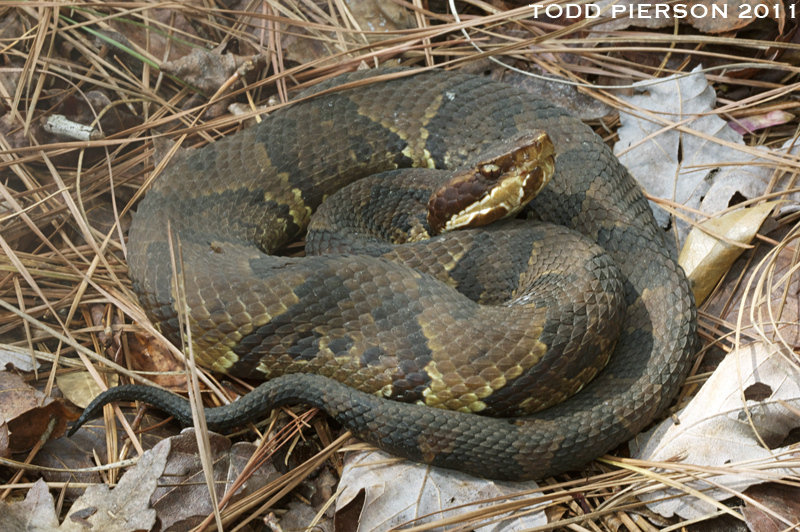
Our Class Mascot: The Cottonmouth Snake (Agkistrodon piscivorus)


     After being able to enjoy and learn at the various sites throughout the semester, I still feel connected to the first field trip to Caw Caw County Park. It was the first time I've ever gotten a chance to really look at herps in the field, and I must say it was a wonderful experience. The first field trip is very near and dear to me, and I could never forget the moment when I laid eyes on the beautiful cottonmouth. The whole class was amazed, as we were impatient from the beginning to catch at least a glimpse of a cool snake. This by far exceeded our expectations and was one the most memorable moments the class experienced. Because of this, I feel the cottonmouth should be our class mascot. 
     The cottonmouth is notable for its deadly venom and forceful bite, and is one that shouldn't be messed with. It's very unique and can easily be recognized due to its facial pits, broad head, elliptical eyes, and front fangs. These qualities in this snake makes it all the more beautiful and mesmerizing, however it should be considered as our mascot because even these snakes are looked down upon by some. These snakes are dangerous, however their danger is overly exaggerated making people fearful of them, which may also lead them to kill or harm the snakes. This is very detrimental to the species and also the environment. People should be aware of these snakes, however they should also be encouraged to not harm them in anyway as this could be detrimental to their population as conservation is quite difficult and species loss is on the rise. 
     The cottonmouth should be considered for our class mascot. Not only is this animal beautiful, it is quite unique and has some amazing qualities that makes it one of the most amazing species I've ever encountered. I was truly amazed, and I hope that with this as our mascot, others will appreciate it just as much as our class did. 

Class Mascot?

I had a lot of fun reading other people had to recommend for our class mascot, and when I have to nominate one, I'm finding myself in a hard situation. I think that hognose snake our Thursday group encountered was super cool and put on a great show for us. But the little ground skink was super dossal and nice to me too! And so were the greater siren, and pretty much every other herpts we've encountered! I've also started to appreciate many of the frogs when I studied for my lab final.

It is a tough decision, and we ARE covering two very different classes in herpetology, so picking any one animal won't really do the other ones, or the other class, justice. And I also agree that we should pick something colorful and attention grabbing. So, maybe we should just let this dragonfly that liked to hang out with us on our last field trip be our mascot?


Just kidding.

Well, if I have to pick one for our CLASS, I'd choose the two-toed amphium, Amphiuma means, since it greated us in huge numbers (8) on the very first field trip, and greeted us with its appearances frequently through the following field trips, including that one that died on the very last trip (sad). They are also very unique in its number of toes, and its smooth defense mechanism. And it's also a peaceful little things that serves the ecosystem well since many water birds like to feed on them. Plus, I'm sure we are all very thankful for the amount of trouble it gave us memorizing its Latin name LOL.        

Class Mascot: Alligator mississippiensis

Our class mascot should be the American alligator or Alligator mississippiensis. Compared to all of the reptiles and amphibians our class has come across on our field trips, nothing was more amazing than seeing these creatures in their natural habitat. Although the salamanders, lizards, frogs, snakes, and turtles were fascinating, nothing compared to the incredible size and beauty of the American alligator. Although our class only came across the alligators on one field trip to Donnelly State Park, when we discovered these creatures at the first site, everyone was amazed. First, the smaller alligators were seen on one side. They got startled and all jumped in the water which in return startled me! As we proceeded to look on the other side of the bridge, three juvenile alligators were spotted. We knew the mother must be close by, and sure enough she was tucked away watching closely in the water. She will continue to watch her young for about two years providing them protecting from predators until they are large enough to fend for themselves. The juvenile alligators were about six inches long and had a beautiful orange striped pattern along their dorsum. After this site we preceded to the last site where a huge alligator was spotted along with many others. All were basking along the side of the water. The first one we saw was breath taking. The scutes along its back were very raised and the alligator was about eleven feet long. Some alligators can reach up to 14 feet and 400-1000 pounds. The adult males are larger than the females. These creatures prefer to live in freshwater habitats where they spend time in the water swimming as well as outside the water basking.


If alligators were our class mascot, it could be our duty to help preserve the species that was once considered endangered. Their large size often scares humans and leads to them being considered a threat. Relocating alligators does not work because of their extreme territoriality. Eventually the alligators can find their way back to their original habitat and this leads to the alligator being caught and killed. If you noticed at Donnelly State Park there were signs reading “A fed alligator equals a dead alligator”. Meaning, people feed the alligators, which leads them to come to trust humans. The alligators will then get extremely close to humans that are in the area in hopes of getting more food. This often scares humans since these creatures are so large and powerful. Humans report the alligators as a dangerous threat and the alligator is then shot and eliminated to prevent them from harming humans. Educating humans about these alligators is extremely important in the conservation of the species.

A Peek into a Huge Turtle Mouth!

I'm posting a very cool video I took at the optional field trip at the Turtle Survival Alliance, featuring us interacting with this awesome Asian brown Tortoises, Manouria emys.(You know it's awesome because it's Asian~)

This particular individual is a female and is estimated to be over 30 years old. It has a hole drilled at the edge of its carapace from when she was captured by the locals to sell to the turtle market. What they do is they put a rope through the hole and tie her up so she can't escape. She is also blind due to cataracts--she thought we were feeding her with food, that's why she kept opening her mouth. She was very friendly (maybe).

I won't say too much, you can find more information from Leah's blog: http://ourherpclass.blogspot.com/2015/04/trip-to-tsa.html , which inspired me to have this post.

(PS: I am super glad that this website saves my work automatically! There was just a power problem where I was and hooray not having to type up everything again!!!)

Class Mascot: Coluber Constrictor


I think that our class mascot should be a snake, specifically the black racer or Coluber constrictor. Snakes are amazing animals, and are greatly misunderstood because not all snakes are dangerous and harmful, as most people wrongly assume! Before taking herpetology I was one of these people who negatively stereotyped snakes, however after studying them and having first hand experiences with them in the field I learned to appreciate them. Thus why I think a snake is the perfect class mascot. It came down to choosing between the cottonmouth (Agkistrodon piscivorus) and the black racer (Coluber constrictor) as our class mascot. A mascot should be something that is very common for the item it represents, thus the fact that our class encountered these two snakes the most often on our field trips make the choice logical. However, given that A. piscivorus is poisonous and that no one had the chance to physically handle one, made choosing C. constrictor even easier.

Displaying 2015-04-29 15.43.07.jpgHere are some other things that aided me in choosing Coluber constrictor as our class mascot. First off, I learned how the black racer got its name . . . because it is an extremely fast and elusive snake! In fact, on two separate occasions C. constrictor was so fast and elusive that we couldn't catch it at all. Black racers are one of the fastest snakes around, which amazed me because they don't even have limbs yet they can move faster than many animals with four limbs! This ability makes the open ground the perfect habitat for C. constrictor, yet they tend to remain relatively close to underbrush so they can quickly get to cover if needed. Furthermore, despite being such aggressive snakes, I never realized how an animal that is plain black could be so beautiful. Its all black body with smooth scales give it a very sleek look with a simplistic beauty. C. constrictor's beauty was magnified even more so at Donnelley Wildlife Refuge, where a classmate found a black racer that was getting ready to molt making its eyes and parts of its belly baby blue. This black racer was extremely eye appealing and definitely still is the coolest looking snake I've ever seen in the wild.

This being said, the black racer should be our class mascot based on three undeniable reasons: it was the most common snake we found in the field, its impressive quickness and elusiveness, and its unadorned beauty. Need there be any other reason!? So I hereby nominate Coluber constrictor to be our herpetology class mascot.
Click here for video of how fast and elusive black racers are