Sunday, April 5, 2015

Snakes in Religion

Seeing as it is Easter Sunday when I am writing this blog post, I thought it was only fitting to talk about snakes in religion. In the Bible, snakes are seen as evil creatures and are directly associated with Satan. Snakes are mentioned in the first book of the Bible in the Garden of Eden. Adam and Eve were told by God to not eat the fruit in the garden but, according to scripture, a snake convinced them otherwise. The serpent tempted Eve into eating the forbidden fruit, thus bringing sin into the world. The same negative connotation towards snakes follows them into the New Testament. In the book of Matthew, the Pharisees and Saducees were referred to as the “brood of vipers” to illustrate the poison, through their words and actions, that they were feeding the townspeople. My pastor today at the Easter service mentioned both of these instances in scripture to reinforce the belief that Jesus took our sins when he died on the cross.


As I searched for scripture to further solidify the claim that snakes are evil in the Bible, I came across a practice that I had never heard of before. This practice is called snake handling. There are churches found in Alabama, Georgia, Kentucky, North Carolina, Tennessee, West Virginia, and South Carolina that practice snake handling and use venomous snakes in the church services. It is believed, by those who practice it, that snake handling is a way to prove to non-Christians that God protects them from harm. They often speak in tongues during the services and some even try to use the venom as a medicinal cure for ailments.

(Pentacostal Church of God, Kentucky courtesy of wikipedia.com)

It plays a small part in their service but snake handling is typically used during prayer, singing, and dancing. Services are held multiple times a week and can last between 90 minutes and 5 hours. The longer services occur when the Holy Spirit “intervenes”. All of the Appalachian States in which snake handling is practiced, with the exception of West Virginia, have outlawed snake handling. Because of this, most of the snake handling services are held at someone’s residence instead of the church. There have been 71 reported deaths through snake handling, but due to its illegality, the actual number is probably much higher.  A lot of the churches that practice snake handling are in remote areas and are not in close enough proximity to hospitals to help them if they do get bitten. Sadly for the snakes, they are not well tended to by their owners and are often in a state of degradation.

I was raised Methodist and was taught that snakes were evil through scripture, which is probably why I had been skeptical of snakes until I took this course. Luckily, I am only wary of venomous snakes anymore. I was completely thrown off when I had heard about snake handling through my friend that is a religious studies major. It is so strange to me in so many ways. While I am religious, I am not hard core, let-me-stand-on-the-corner-and-pass-out-religious-fliers religious. I am religious for myself and that is it and I think that is why their eccentric practices are so strange to me. At no point in my life have I felt compelled to hold a venomous snake in the name of Christ to prove my devotion to him. I should say, I am not bashing their practices or beliefs, but simply saying that I could not see myself doing the same thing they do. What saddens me the most about this practice is the way they treat the snakes. Often the church has dozens of snakes and it is impossible to take care of all of them the way they should be; they are often dehydrated and hungry. While this is good for those handling them, as the venom is less potent in a deteriorated snake, it is unfair to the snakes. 

Happy Easter everyone!

Audrey 

Influences of Water Management on Alligator Nesting


After last week's discussion on wetland use by turtles, I decided to research some literature on wetland use by alligators. I came across an article about the influences of water patterns on nesting behavior and nest survival in alligators in the Everglades. The article focused on the fact that due to their sensitivity to changes in ecosystem hydrology as far as reproductive success is concerned, alligators are a great indicator species for the effects of wetland availability and hydrological modifications.

According to the article, there are two main factors of altered water patterns that affect alligator life in terms of wetlands: reduction of wetland area for reproduction and changes in annual water (hydrological) patterns. During the study researchers measured hydrological patterns using harmonic models and examined their effects on alligator nest survey data over a 20 year period. Surveys were done in Shark Slough, Everglades National Park. The water levels in this area of the Everglades are controlled by water holding and discharge mechanisms North of the research area that allow for use of water by humans for residential and agricultural practices. Modulations to these mechanisms and subsequent water availability in the research area were shown to be primary causes in nest failure and reproductive success of alligators Researchers found that there were larger numbers of nests in years when average annual water depth was greater. This told researchers that increasing water levels delivered into the Everglades would allow for more suitable wetland habitat for alligators. At times when there was severe drought and more water was withheld from flowing into the Everglades, alligators were found to nest at sites of lower elevation. In general withholding of water in drought is generally accompanied by a large discharge from the withholding mechanisms early in the wet season producing high nest flooding and failure rates since nests were built at lower elevations. Thus greater nest failure/flooding was correlated with extreme dry seasons and extreme wet seasons. The authors believe that better management of wet season water discharge, and in particular gradual water release into the Everglades, could help prevent high alligator egg mortality due to flooding of nests.

I think that this research is very important in the field of herpetology because it presents more long term evidence about the nature of reproductive survival of herps depending on wetland habitat availability and modulation. The authors also mention at the end of the article that the effect of hydrological pattern modulations are not just affecting alligators but other non-herp animals such as fish and wading birds whose nesting and primary food sources come from wetland areas. I think the data from this article supports efforts of wetland conservation as well as better water management practices. The information from this article has the potential to open the eyes of the general public to how their residential water usage can affect a truly charismatic species and the ecological treasure that is the Everglades.

http://onlinelibrary.wiley.com.nuncio.cofc.edu/doi/10.1002/jwmg.463/full

Ugarte, C. A. et al. 2013. The Influence of Regional Hydrology on Nesting Behavior and Nest Fate of the American Alligator. Journal of Wildlife Management. 77 (1): 192-199. 

Natural History: Carolina Pigmy Rattlesnake

I had an amazing opportunity to partake in a herpetology survey in a local national forest, where a portion had undergone prescribed burning in the previous week. The ground was black from the ash of the burnt vegetation and although it was cloudy that day, you could still feel some heat radiating from it as it made the surface of the ground warmer than the surrounding air. Our goal was to find rare species of that area for documentation and further research, with one of the animals being the well-known Eastern Diamondback Rattlesnake (Crotalus adamanteus), a personal favorite of mine. While walking through the sparse woods, the vegetation crunching under my hiking boots, it almost seemed hopeless to see any kind of snake due to the lack of sun, though. It was relatively chilly out as well, so I almost lost hope to see many snakes until my group and I stopped briefly along a trail. While investigating near a hollowed log, I caught a bright coloration out of the corner of my eye and saw the first snake of the day, a Carolina pigmy rattlesnake (Sistrurus miliarus). While not the one we sought, it was an exciting sign since it meant that the snakes were indeed coming out to take advantage of any warmth from the ground.

I estimate that this little rattlesnake was only between 5 to 6 inches long, being a baby while the adult form typically grows to be between 15 and 21 inches long. Unfortunately, no sex could be determined with confidence due to how small it was and the fact that it was curled with its tail hidden, which is typically looked at for sex determination. Also, we could not clearly see the rattle and had to look at other distinguishing features to make a positive identification at first. Once some high definition pictures focusing on its head were taken, it can be seen that it has a facial pit, which automatically told us that it was of the family Crotalidae. Its head was also wider than its neck, giving a classic V-shaped head rather than a rounded one. Next was the brilliant pattern it was presenting to us! I was amazed to see how colorful it was, but it allowed a clear look at the pattern of the dark lateral spots in a row on its sides and the middorsal “russet stripe,” or in other words alternating colored stripes of red and black or dark gray. The russet stripe is original to S. miliarus compared to the other rattlesnakes and venomous snakes of the area. Sistrurus also have a group of nine plates on the crown of the head that distinguishes them from the other rattlesnakes. Due to the tiny rattle and very slender tail of this species, even if it rattled (which an adult female did for us only a few minutes later after we continued our search), we would not be able to hear it. S. miliarus is considered to use more visual warning out of the rattlesnakes because of the small rattle that releases such a quiet sound, explaining why it has likely evolved brighter coloration than other rattlesnakes of the area. I was ecstatic when I came across this handsome rattlesnakes, partly because it meant more snakes would be out, but also because it was my first rattlesnake experience in the wild. The experience will never leave my mind and even as I write this, I cannot stop smiling because of how amazing that one moment was in my life.

Tourism and Turtles

The Greek Islands are world-renowned tourist destination for their white washed villages, and crystal clear blue water. Many Greeks rely on tourism as their primary source of income, so much that economic development has effected ecological conservation. Many tourists travel to remote islands to experience unforgettable landscape, warm weather and friendly locals. Ironically, tourism is considered one of the most detrimental threats to the Mediterranean loggerhead, Caretta caretta.


Tourism has driven the species to few secluded islands over the last 30 years. The island of Zakynthos is now one of the most important nesting areas for the loggerhead. Until the 1980’s, the beaches surrounding this island were undeveloped. As tourism increased, beach development led an encroachment on nesting areas and caused turtle populations to drastically decline. The islands night life of greek tavernas involving live music and lots of dancing creates a tremendous amount of noise pollution. This interferes with female turtles and disorients them so much that they are unable to make it to their nesting areas. Some eggs have been reported to get deposited in the ocean and do not even make it to the beach. The renting of umbrellas pierces eggs in their nests and has been proven to lower sand temperature, which alters incubation. Excessive litter gets mistaken for the loggerheads favorite food, the jellyfish, and is consumed and leads to death.

The situation in Greece is one that is not only specific to Zakynthos. World wide, Loggerhead populations are globally threatened because of human infliction. It is important to recognize how we are shaping the future of a species that has been on this earth for 300 million years, and if we do not strive to change our actions, we will lose them forever.


Saturday, April 4, 2015

The Red-Eyed Tree Frog


While studying abroad in Panama last summer, I came across one of my favorite frog species, the Red-Eyed Tree Frog (Agalychnis callidryas). I first found a cluster of eggs hanging from a large leaf that was positioned over a small area of standing water on a cement sidewalk. Red-Eyed Tree Frogs lay their eggs over water so that when the eggs hatch, tadpoles land in the water underneath them. The frog did not recognize that this little area of water would be dried up very soon, so the herpetologist on the site moved the eggs to a safer location. After looking around for awhile on the same plant that the eggs were located, I finally found the frog hanging out on a nearby leaf. Tree frogs are nocturnal and come out to hunt at night for small insects, so when I initially found the frog its eyes were closed. I nudged the frog a little bit and it woke up and revealed its beautiful red eyes. 


Adult Red-Eyed Tree Frogs are bright green, with blue and yellow striped sides, and orange/red feet. When a predator approaches, the frog flashes its bright red eyes and untucks its brightly colored legs, momentarily confusing the predator with these bright colors so that the frog can escape. These frogs can be found in tropical lowlands from southern Mexico, all the way to northern South America. 


Male Red-Eyed Tree Frogs typically mature around 2 inches, while females are larger and mature around 3 inches. This was a very large frog, and I assume it was a female. A few days after the first cluster of eggs were removed, I found another clutch of eggs. This particular clutch of eggs had a considerably larger area of jelly like substance surrounding the eggs than the first clutch that I found. The other eggs must have been a few days old, while this one was most likely laid the night before. The frog stuck around in the same place the entire two weeks I was there, so every once in awhile I would take a look, and I held the frog once or twice just to check out its vibrant colors on its side. 


Thursday, April 2, 2015

Do Amazonian Rivers Define the Boundaries of Different Species of Amazonian Lizards?

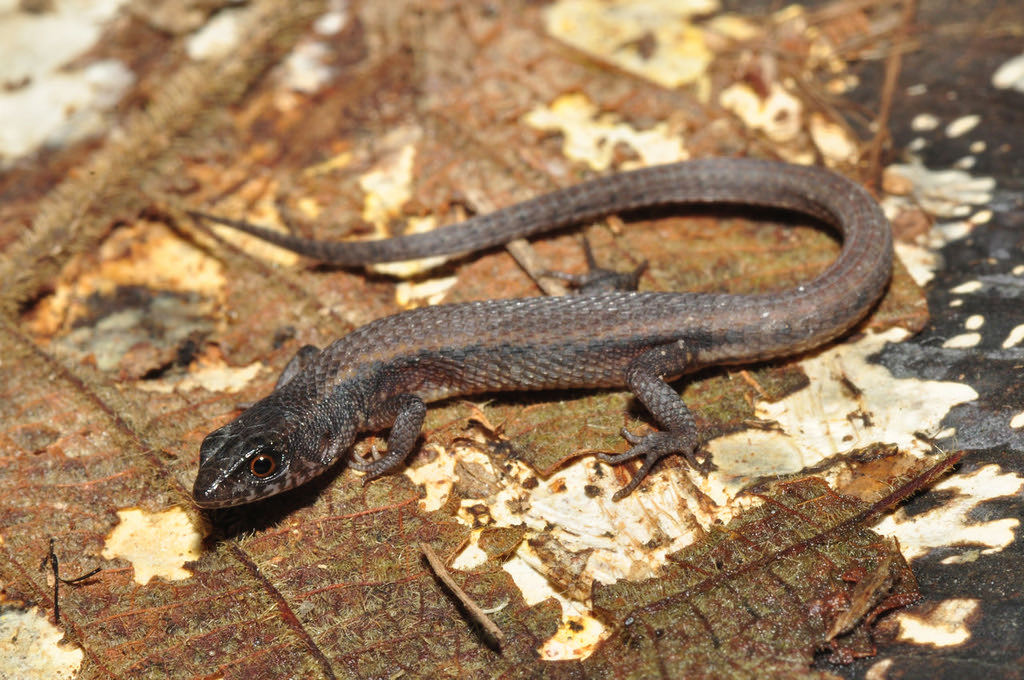
Prior to reading this study I had never really thought about the idea of a river defining the boundary of an area where a specific species occurs. Perhaps because many of the rivers here in the low country are quite a bit smaller and better behaved than the vast expanse of Amazonian Rivers. But it turns out there are well documented accounts of species boundaries being limited by different rivers commonly in Amazonian bird and primate species. This study titled, "Are Amazonia Rivers Biogeographic Barriers for Lizards? A Study on the Geographic Variation of the Spectacled Lizard Leposoma osvaldoi,"  published in The Journal of Herpetology, and authored by Mario Cohn-Haft, Miguel Rodrigues, and Sergio Souza, examined whether or not this effect was taking place in the spectacled lizard. The article states that lizards in the genus Leposoma appear to possibly be good nominations for this phenomenon, and that they are the second most diverse genus in the area behind Anolis. Lizards within this genus are small in size and generally inhabit upland forest floors within leaf litter. The great amount of diversity accounts for the recent discovery of the spectacled lizard, and this study looked at whether morphological diversity existed between different geographic populations. These lizards persist mainly in a portion of the Amazon called the Rio Madeira basin, so they examined specimens from the land near the Madeira and it's three tributaries.


Specimens began being collected in 2005 up until 2013 and were stored in a Brazilian herpetology institute for morphological analysis. They also were able to use specimens previously collected by others and stored at a nearby zoological center. In total sixty six specimens were available for examination, forty four males and twenty two females. They examined the lizards by taking digital pictures using a camera connected to a stereomicroscope and using Adobe photoshop to take precise measurements. Twenty measurements were taken on all specimens observing various scale and body feature widths and lengths. Of these twenty different measurements eleven showed sexual dimorphism, with males being the larger of the two sexes, most notably head width. And females had selection towards having longer body lengths. Interestingly sexual head size dimorphism is a phenomenon that is also seen in other members of the spectacled lizards' family Gymnophthalmidae. This selection is said to be explained by aggressive behavior between males, biting during copulation, and differing diets of males and females. Longer bodies in females also has it's own definiton, sexual size dimorphism, and is said to be explained by advantages in fecundity for longer (larger) females. This is the first time both of these phenomenon have been documented in this species. More importantly geographic morphological variation was observed in parietal head scales, but distance between differing specimens did not seem to have an effect, so other factors may be the cause of morphological differences. The study concluded that although morphological differences were observed, the rivers between them appeared to have little influence, but further examination from a genetic standpoint and better phylogenetic understanding may be necessary for a more conclusive answer. If you want to know more check it our for yourself at http://www.bioone.org/doi/abs/10.1670/12-124

Wednesday, April 1, 2015

"A Phylogenomic Analysis of Turtles"


For the past few decades, the placement of Testudines relative to other reptiles on the phylogenetic tree has been a heavily debated topic among scientists, herpetologists in particular. However, due to much research, some of the doubt has been removed. We now believe turtles are amniotes who are more closely related to crocodiles and birds rather than squamates and tuatara. Although we have gained a lot of insight, studies have not focused on the genomic links within the order itself.
In this study, the researchers assess the relationships among turtles. Researchers collected DNA from 32 turtles, in which each family is represented, and 6 out-group organisms, ranging from a mammal to a squamate. Researchers sequenced and assembled the DNA using a relatively new technique called ultra-conserved elements. They then used statistical models, in which each program assembled the same phylogeny.

Scientists extracted DNA from each organism and generated sequences for each. However, this study used a relatively new technique called ultra-conserved elements. This phylogeny happened to be the same as the currently accepted tree, meaning the phylogenetic names correlated with the genus, species, etc.

In rooting the phylogenetic tree, the scientists interestingly created, or defined, a new phylogenetic group. Archelosauria is a clade that includes the both archosaurs and chelonians, meaning this group includes turtles, crocodiles, dinosaurs, and birds. This is one of the largest, if not the largest, vertebrate groups to ever receive a scientific name.

Thus study also showed that molecular phylogenies are more credible than morphological topology. Using ultra-conserved elements, scientists are able to better reconstruct recent divergences. Assessing the organisms’ DNA will always be a better method to construct a phylogeny than assessing its morphology. There are numerous cases of convergent evolution that could cause confusion in constructing a phylogeny via morphology. The article gives the example of Trionychians. Morphology-based phylogeny constructions place them in Crytopdira, which is clearly not the case.

Therefore, all future studies should use genomic or molecular methods to create the most believable phylogeny.


Nicholas G. Crawford, James F. Parham, Anna B. Sellas, Brant C. Faircloth, Travis C. Glenn, Theodore J. Papenfuss, James B. Henderson, Madison H. Hansen, W. Brian Simison, A phylogenomic analysis of turtles, Molecular Phylogenetics and Evolution, Volume 83, February 2015, Pages 250-257, ISSN 1055-7903, http://dx.doi.org/10.1016/j.ympev.2014.10.021.